Acumatica Construction Partner of the Year — 2025 & 2026
Strategies Group is one of a small number of Acumatica Gold Certified VARs to receive back-to-back Construction Partner of the Year honors at Acumatica Summit. This recognition is based on implementation volume, customer satisfaction scores, and depth of expertise in advancing Acumatica’s construction platform. We also hold membership in the Acumatica Presidents Club — reserved for the most successful Gold Certified partners in the ecosystem.
Acumatica is a powerful platform. But every Acumatica implementation we’ve taken over from a previous partner tells the same story: the software wasn’t the problem. The implementation was.
Strategies Group has been implementing Acumatica exclusively since 2018 — no other ERP, no hedging. In that time, we’ve completed hundreds of implementations for construction, manufacturing, distribution, and field service companies across North America. We’ve been named Acumatica Construction Partner of the Year two years running, and our customers include Acumatica’s Construction Customer of the Year for both 2025 and 2026.
This page is for organizations evaluating Acumatica implementation partners — whether you’re preparing for your first implementation, recovering from a troubled one, or looking to get more from a system you’ve already gone live on.
Here’s what separates a great Acumatica implementation from an expensive one: the partner you choose before you sign anything.
What to Look for in an Acumatica Implementation Partner
There are over 200 certified Acumatica partners worldwide. The differences between them are significant — in industry depth, methodology, post-go-live support, and the degree to which Acumatica is truly their core competency versus one product in a broader catalog.
The four factors that most consistently determine implementation success:
- Exclusive or near-exclusive Acumatica focus. Multi-ERP generalists divide their training, tooling, and institutional knowledge across platforms. Partners who specialize build deeper configuration pattern recognition and solve your edge cases faster because they’ve already solved them before.
- Demonstrated industry experience in your specific vertical. Construction accounting is fundamentally different from distribution or manufacturing. A partner who has implemented Acumatica for 50 specialty contractors understands WIP schedules, AIA billing, and subcontractor management in ways a generalist does not.
- A transparent, phased implementation methodology. Partners who push for everything in the first release create budget overruns and delayed go-lives. Look for a disciplined phase 1 scope that prioritizes your most critical business processes and delivers measurable value within a defined window.
- A real post-go-live support model. Implementation ends at go-live; the relationship should not. Dedicated customer success managers, structured support SLAs, and annual system reviews are markers of a partner invested in your long-term outcomes.
Why Your Acumatica Partner Matters More Than the Software
Many Acumatica implementations fail to hit timelines or ROI targets not because of Acumatica itself, but because of weak implementation approach and partner fit. Industry benchmarks show that ERP implementations achieve a 75% success rate with expert consultants versus just 45% for organizations working with less experienced teams.
Acumatica is a powerful cloud ERP platform designed for mid-market companies seeking unlimited user licensing, native mobile access, and real-time business intelligence. However, its speed to value is determined largely by who designs, configures, and rolls it out. The capabilities are there — unlocking them requires deep understanding of your business operations and Acumatica’s architecture.
The strategic decision for most organizations isn’t “Acumatica or something else.” It’s “which Acumatica implementation partner can get us there fastest, with the least risk?” This is especially true when comparing Acumatica to platforms like Oracle NetSuite or Microsoft Dynamics 365, where the partner’s implementation expertise often shapes outcomes more than feature differences between systems.
Strategies Group operates as a single-product Acumatica partner. We bring structured implementation methodologies and industry-specific playbooks developed across hundreds of projects — not generic ERP consulting applied to Acumatica after the fact.
Key Takeaways
- The right Acumatica implementation partner compresses timelines from 9–12 months to 4–6 months while reducing project risk — through structured requirements definition, native configuration, and proven change management.
- A strong partner accelerates time-to-value by translating your business needs into Acumatica configuration quickly, without unnecessary customization in the first release.
- Data migration, integrations, and user adoption are where experienced Acumatica consultants save you months by applying playbooks from dozens of prior implementations.
- Over 55% of ERP implementation projects overrun budget. The difference is almost always implementation process and partner quality — not the software.
- Strategies Group’s 6D methodology (Align, Discover, Design, Deploy, Deliver, Maintain & Optimize) extends partner engagement from pre-sale through long-term optimization — not just go-live.
From Vendor Demos to Real Requirements: Getting Acumatica Right Up Front
Most companies arrive at an Acumatica decision after seeing polished demos — but still lack a clear, prioritized requirements list. The gap between “that looks great” and “here’s exactly what we need configured” is where implementation services prove their worth.
An experienced Acumatica partner facilitates structured discovery workshops to translate high-level goals into concrete use cases and configuration requirements. This involves:
- Documenting current processes across finance, operations, and customer-facing teams
- Identifying inefficiencies in existing workflows that Acumatica can address
- Mapping business requirements to specific Acumatica modules and features
- Prioritizing by business impact rather than attempting to solve everything at once
Requirements Differ by Industry — Especially in Acumatica’s Core Verticals
Acumatica is purpose-built for construction, manufacturing, distribution, and field service — and each vertical has distinct configuration requirements that a specialist partner understands deeply:
| Industry | Key Acumatica Requirements Focus |
| Construction | Project accounting, WIP adjustments, subcontractor management, field mobility, AIA billing |
| Field Service | Dispatch scheduling, mobile work orders, contract management, inventory at technician level |
| Manufacturing | Production scheduling, BOM management, shop floor control, lot/serial tracking |
| Distribution | Multi-warehouse operations, landed cost, customer-specific pricing, order orchestration |

Defining a Realistic Acumatica Phase 1 Scope
A typical Acumatica Phase 1 scope includes:
- Core financials: GL, AP, AR, cash management
- Distribution or project accounting (depending on primary business model)
- Two to three critical integrations (payroll, CRM, or e-commerce)
- Role-based dashboards for executives, project managers, and key operations staff
Example: A specialty contractor defines Acumatica requirements for project cost tracking, AIA billing, subcontractor compliance, and field mobility. The partner maps each requirement to specific Acumatica modules, identifies what requires configuration versus ISV extension, and builds a requirements matrix that becomes the foundation for accurate scoping and timeline estimation.
Configuring Acumatica for Rapid Wins, Not Endless Customization
Acumatica’s flexibility is both a strength and a risk. Without experienced guidance, organizations over-customize and delay go-live — sometimes by 6 to 12 months. The platform offers extensive configuration options, but that openness requires discipline to prevent scope creep from taking over Phase 1.
The right Acumatica implementation partner prioritizes native configuration over heavy custom development in the first release. This includes leveraging:
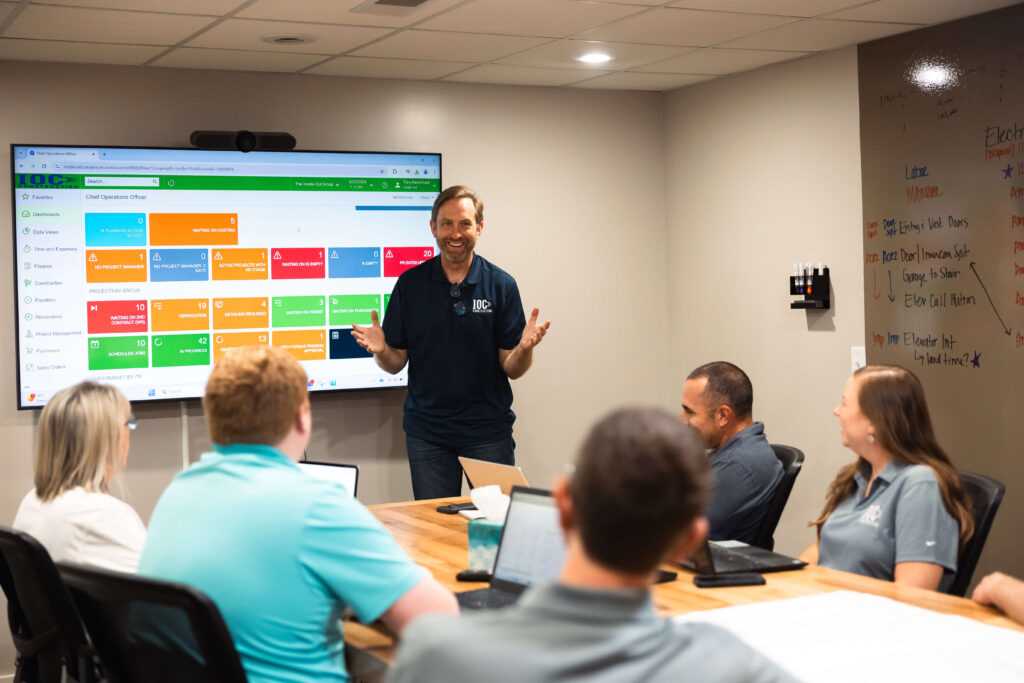
- Role-based dashboards for CFO, operations manager, project manager, and warehouse supervisor views
- Generic inquiries for custom reporting without code
- Workflow automation for approvals and notifications
- Import scenarios for data updates and mass changes
When to Configure, Extend, or Build in Acumatica
Strong Acumatica partners establish clear rules for technology decisions before touching the system:
| Approach | When to Use | Examples |
| Configure | Feature exists natively in Acumatica | Custom fields, workflow rules, approval routing, dashboard widgets |
| Extend (ISV/3rd party) | Proven add-on solves the need cleanly | EDI, advanced shipping, payment processing, payroll integration |
| Custom development | Critical gap with no existing solution | Unique industry calculations, proprietary integrations, bespoke reporting |
The partner should establish a configuration roadmap beginning with mission-critical business process flows that deliver measurable wins within 90–180 days:
- Order-to-cash: quote, order, ship, invoice, collect
- Procure-to-pay: requisition, PO, receipt, bill, payment
- Project accounting: estimate, track, bill, recognize revenue
Partners who push custom development early in Acumatica implementations create technical debt that slows future upgrades and complicates ongoing support. Configuration-first is a discipline, not a limitation.
Data Migration, Integrations, and Change Management: Where Partners Save You Months
Timelines slip most often in three areas: data migration, integrations, and user adoption. An experienced Acumatica implementation consultant brings structured approaches to each.
Data Migration
Migrating data from legacy systems — Sage 300 CRE, Sage 100 Contractor, QuickBooks, Microsoft Dynamics, or custom spreadsheet environments — into Acumatica requires careful mapping, cleansing, and validation. Research indicates that 83% of ERP users report data issues during implementation when data preparation is treated as an afterthought.
Strategies Group has managed data migrations from dozens of legacy systems and treats data as a strategic workstream from day one: mapping source systems, cleaning records, consolidating duplicates, and validating accuracy before any data enters Acumatica.
Integrations
Acumatica’s open REST API enables real-time connectivity with payroll platforms, CRMs, project management tools, estimating software, and industry-specific ISVs. The integration architecture decisions made during implementation determine how well these connections scale as your business grows.
An experienced Acumatica partner evaluates integration needs during requirements definition — not after go-live — and builds an integration map that accounts for data direction, frequency, and failure handling before any code is written.
Change Management and User Adoption
ERP touches people’s daily work — every approval, transaction, and report. This triggers resistance among employees who have mastered existing systems. Poor user adoption is one of the leading causes of post-go-live underperformance, regardless of how well the system is configured.
Strategies Group’s implementation methodology includes structured user training by role, go-live support during the cutover period, and post-go-live check-ins to catch adoption issues before they become support tickets.
How Strategies Group Implements Acumatica: The Methodology
Every Strategies Group Acumatica implementation follows our 6D methodology — a structured process developed over hundreds of projects that extends partner engagement from pre-sale through long-term optimization:
- Align — Define software requirements, validate Acumatica fit, and establish mutual success criteria before any implementation begins
- Discover — Structured discovery workshops to document current processes, identify inefficiencies, and map requirements to Acumatica modules
- Design — Configuration architecture, data migration planning, integration design, and phase 1 scope definition
- Deploy — System configuration, data migration, integration setup, user training, and go-live execution
- Deliver — Go-live support, cutover assistance, and immediate post-go-live stabilization
- Maintain & Optimize — Ongoing support, quarterly check-ins, annual system evaluations, and continuous improvement planning

FAQ
Is Acumatica your only ERP, or one of several you implement?
Strategies Group implements Acumatica exclusively — it has been our only ERP platform since 2018. Every consultant on our team works in Acumatica daily. We don’t split resources, training, or institutional knowledge across multiple platforms. That singular focus is reflected in our two consecutive Acumatica Construction Partner of the Year awards and our Acumatica Presidents Club membership.
How many Acumatica implementations have you completed in our industry?
Strategies Group has completed hundreds of Acumatica implementations across construction, manufacturing, distribution, and field service. In construction specifically — our deepest vertical — we’ve implemented Acumatica for general contractors, specialty contractors, concrete contractors, restoration contractors, and wall and ceiling contractors across North America. We’re happy to connect you with reference clients in your specific trade before you make any commitment.
What does your post-go-live support model look like?
Every Strategies Group client is assigned a dedicated Customer Success Manager at the start of the engagement — not handed off to a general help desk after go-live. Your CSM conducts quarterly check-ins, leads annual system evaluations, and serves as your primary point of contact for support, optimization, and strategic guidance as your business evolves. We define SLAs at the start of the engagement so there are no ambiguities about response times or escalation paths.
Can you show us a client reference in our industry?
Yes — and we offer this proactively, not just when asked. We can connect you with reference clients in construction, manufacturing, distribution, and field service who have implemented Acumatica with Strategies Group and are willing to speak candidly about the experience: the implementation process, the go-live, and what the system looks like 12 or 24 months in. We recommend requesting a reference call before signing any agreement with any Acumatica partner.
What is your methodology for scoping Phase 1?
We use a phased approach anchored in our 6D methodology: Align, Discover, Design, Deploy, Deliver, and Maintain & Optimize. Phase 1 is scoped during the Discover and Design stages to include the business processes that must be live on day one — typically core financials, your primary operational module (project accounting, manufacturing, or distribution depending on your business), and two to three critical integrations. We deliberately exclude complexity that can be addressed in Phase 2, which keeps go-live timelines realistic and prevents the budget overruns that come from trying to do everything at once. Our target for a mid-market Phase 1 is 4–6 months from kickoff to go-live.
Ready to Talk About Your Acumatica Implementation?
Whether you’re evaluating Acumatica for the first time, recovering from a troubled implementation, or looking to optimize a system you’ve already deployed — Strategies Group brings the construction and industry-specific expertise to get you where you need to go.
Our approach to the sales process mirrors our implementation philosophy: we’re not trying to convince you that Acumatica is right for you. Our goal is to understand your business, build a high-level picture of what your system needs, and be direct with you about fit before either of us commits to anything.
Schedule a no-commitment needs assessment with a Strategies Group Acumatica consultant.